Last October Stats NZ said Queenstown Lakes had 53,800 residents. Last week it announced the district has 53,700 residents.
No, 100 people did not leave. Stats NZ has cut its estimate of last year’s population by 1,100 and now says the district grew 0.4% in the year to June 2025 and 1.9% in the year to June 2026.
I do not believe it.
Queenstown Lakes has grown at an average rate of 4.1% a year for 20 years. That is close to 1,500 extra residents every year. Stats NZ now has us adding 2,200 people in the three years since the 2023 Census. Outside the closed border years, that is the weakest stretch in the 30-year series, at a time when building consents in the District have gone through the roof.
The whole revision sits in one number: net international migration. A year ago Stats NZ had 960 net migrants arriving from overseas in 2024 and 50 in 2025. It now has halved the 2024 figure to 430, said we lost 630 net international migrants in 2025 and lost a further 110 in 2026. For a district where 41% of residents were born overseas, two years of net international outflow is a bold call.
It is also a modelled call. The first estimate of where overseas migrants settle is imputed from where earlier migrants lived, not observed, and it is not finalised for two years. For most districts that is fine. For the fastest growing migrant destination in the country it is a recipe for large revisions like what Stats NZ has just published.
But every reasonable indicator that counts people, or the homes they live in, says something different, and frankly the numbers being published don’t pass the sniff test of what we are seeing day-to-day.
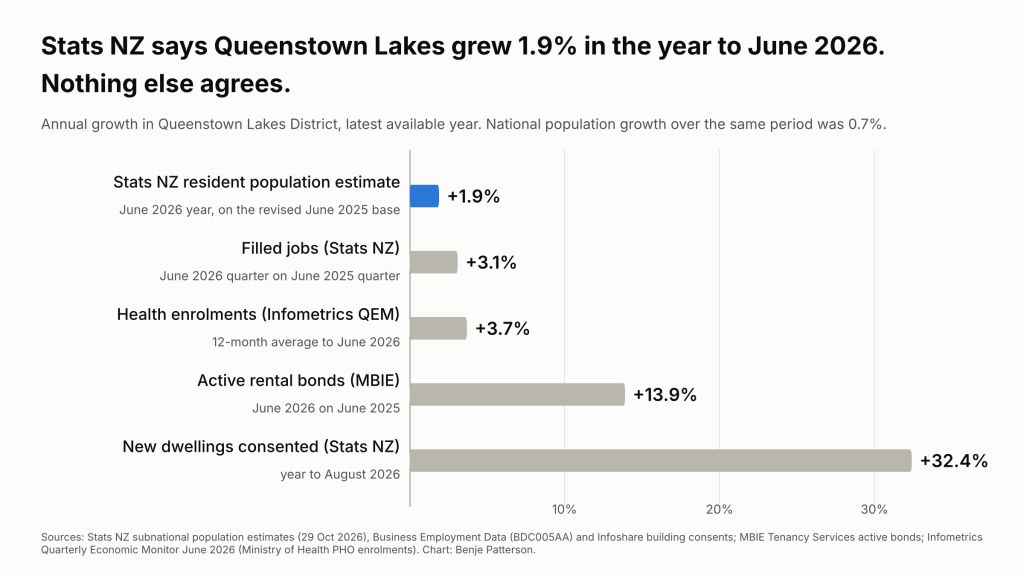
A record 2,080 new homes were consented in the year to August 2026, more than double the 20-year average of about 940. Almost 5,000 over three years.
Active rental bonds rose 14% in the year to June, from 4,653 to 5,298. Those 645 extra rentals alone could house close to 2,000 people, almost 4% of the population. On a 12-month average basis bonds were up 17%.
Health enrolments rose 3.7%, against 0.9% nationally.
Filled jobs rose 3.1%.
None of these is a population count. But the indicators are independent of each other and of the Stats NZ migration model, and they all point the same way. It would be a remarkable coincidence for housing, health and jobs to all be growing at rates multiple times higher than the rate of population growth.
The June 2026 estimate should be treated as a floor, not a central estimate, and unfortunately is likely to be heavily revised again by Stats NZ in future. This situation is unhelpful for the Council and other infrastructure and service providers who need access to good data for planning. The order-of-magnitude of potential planning errors from reliance on inadequate population baselines and growth trends are large. Queenstown Lakes has very different population characteristics to elsewhere and this needs to be better reflected in estimates.